
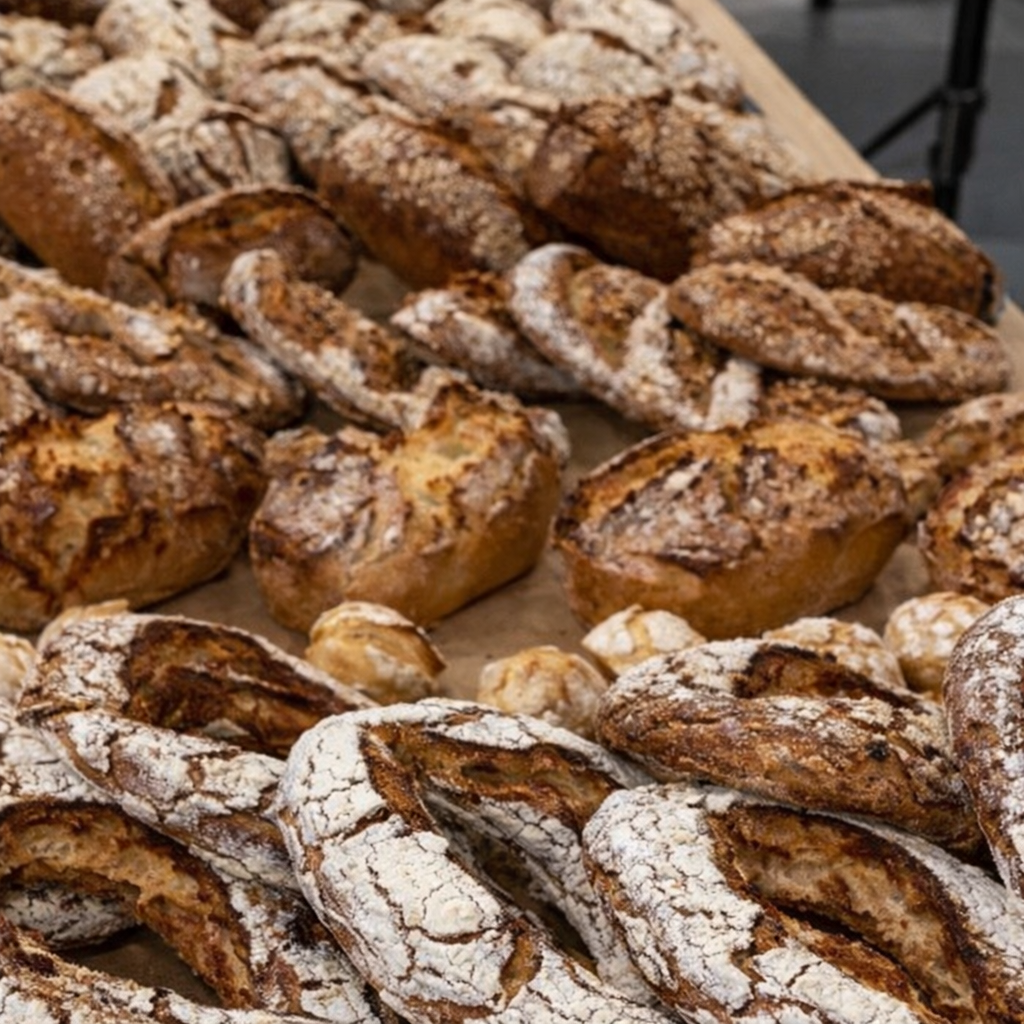
Bread can be eaten... or it can be understood
Eating bread is easy.Understanding it changes everything.
When you learn to look at a crumb, to hear a bark or notice a long fermentation in the mouth, you don't go back anymore.
In this guide we teach you how totaste bread like you taste wine, but without unnecessary technicalities or gastronomic posturing. Just common sense, curiosity… and good bread.
In less than 10 minutes you will know how to distinguish a “correct” bread from a professional bread.
The minimum to set up a mini-tasting at home
You do not need a laboratory or fine glass cup. Solo:
3 types of bread
- rustic loaf (long fermentation, thick crust)
- Pan type candeal or miga prieta
- Whole grain or whole grain bread
To accompany
- 2 oils (a soft one, an intense one)
- 2 cheeses (one fresh or semi-cured and one cured)
- 1 drink (vino, craft or non-alcoholic beer)
Basic tools
- serrated knife
- wooden board
- Napkins
- a notebook (Yeah, you are going to take notes)
The step-by-step tasting (los 5 senses)
1. Vista: what the bread tells you before you touch it
Observa:
- Crust: Golden or pale color? Does it have natural hair?
- Volume: Has it developed well?
- Micah: Irregular alveoli (good fermentation) or compact?
- Color interior: Uniform white or with cream nuances?
A crumb with irregular alveoli usually indicates slow and careful fermentation..
2. Touch: squeeze without fear
Lightly press the crumb.
- Does it return to its form? → Correct elasticity
- Are you left sunk? → Possible overfermentation
- Is it moist but not sticky? → Ideal balance
The texture already tells you about the work behind.
3. Smell: first the crumb, then the crust
Bring the bread to your nose.
- Crumb → dairy notes, cereal, yogurt, dried fruits
- Crust → toast, caramel, malta
A well fermented bread has aroma. If it doesn't smell like anything, says a lot.
4. Boca: flavor and “flavor”
Chew slowly.
Here the retronasal magic happens:
- Natural sweetness of the cereal
- Light balanced acidity
- aromatic persistence
Good bread is not flat. Evolves while you chew it.
5. Ear: Yeah, bread can also be heard
Breaks the bark near the ear.
If it sounds dry and firm → good cooking.
If it barely creaks → poorly managed humidity or poor conservation.
Express bread dictionary
- living crumb → elastic, moist and structured.
- Correct fermentation → complex flavor, nothing aggressive.
- Balanced acidity → pleasant freshness, not vinegary.
- sad bark → mix, characterless.
- flat bread → without aroma or evolution in the mouth.
Pairings that do work
| type of bread | Oil | Queso | When to enjoy it |
|---|---|---|---|
| Sourdough loaf | intense EVOO | cured cheese | Special appetizer |
| Candeal | mild oil | Semi-cured | Traditional food |
| Integral | AOVE fruity | fresh cheese | Breakfast or brunch |
| Bread with seeds | picual oil | aged cheese | Tabla gourmet |
simple rule:
Bread with long fermentation → supports powerful flavors.
More neutral bread → accompanies, does not compete.
Typical errors (and how to avoid them)
- Tasting cold bread from the refrigerator
- Store it in plastic (softens the crust)
- Mixing too many flavors at once
- Do not let the bread rest after cutting it
Practical advice: Store the bread in a cloth or paper bag and consume it at room temperature.
And now what?
Reading about bread is fine.
Trying it with an expert guide is another story.
If you want to live it step by step
Sign up for our guided tastings and discover how your perception of bread changes when someone helps you understand it.
Would you prefer to start today??
Consult our points of sale and try breads made with long fermentations and selected raw materials.
Do you have doubts?
Write to us. We love talking about bread.